
The “Oven Effect”: Why Austin Homeowners are Upgrading
Living in Central Texas comes with a specific set of challenges. As any Austin resident knows, the summer months aren’t just “warm”—they are a relentless barrage of triple-digit temperatures and high humidity that puts every part of your home to the test. While we often think about our HVAC systems and attic insulation, there is one massive, often-overlooked weak point in the home’s thermal envelope: the garage door.
For many homes in neighborhoods like Circle C Ranch, Steiner Ranch, or Mueller, the garage is a multipurpose space. It’s a workshop, a gym, a storage unit for expensive outdoor gear, or the primary entry point for the family. However, an uninsulated or poorly installed garage door acts like a giant radiator. On a 105°F Austin afternoon, the surface of a standard hollow-back steel door can reach temperatures exceeding 140°F. This creates the “Oven Effect,” where heat radiates through the garage walls and into the living spaces above or adjacent to it.
This is where Alpine Garage Doors Texas comes in. We specialize in residential garage door installation in Austin, TX, focusing on high-performance, energy-efficient solutions designed specifically for our unique climate. Investing in a modern, insulated door isn’t just about “curb appeal”—it’s about home comfort, lowering your Austin Energy bills, and protecting your property from the brutal Texas sun.
The Science of Cool: Understanding R-Value and U-Factor
To choose the best door for an Austin home, you have to understand the technical metrics that search engines and engineers use to measure efficiency. If you’re looking for a “best-in-class” blog, you need to provide your readers with the data to make an informed decision.
1. What is R-Value?
In the world of garage doors, the R-value is the measure of thermal resistance. The higher the R-value, the better the material is at preventing heat from traveling through it. For an Austin garage door installation, the R-value is your primary defense against the afternoon sun.
- Non-Insulated Doors (R-0): These are single-layer steel sheets. In the Texas heat, they offer zero protection.
- Medium Insulation (R-6 to R-10): Good for temperate climates, but often struggles during a July heatwave in Travis County.
- High-Efficiency Insulation (R-12 to R-18+): This is the “Gold Standard” for Alpine Garage Doors Texas. These doors utilize thick layers of insulation to ensure that the heat stays outside, keeping your garage significantly cooler than the ambient outdoor temperature.
2. Polyurethane vs. Polystyrene: The Insulation Battle
Not all insulation is created equal. When we perform a residential garage door installation in Austin, TX, we typically offer two types of internal cores:
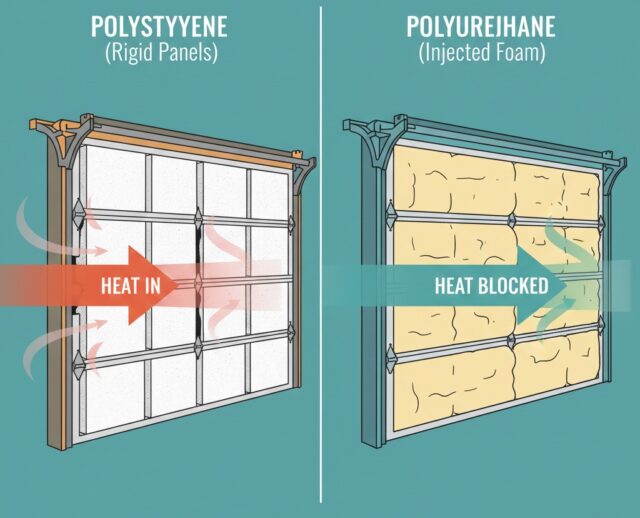
- Polystyrene (Styrofoam): These are rigid panels inserted into the door. While better than nothing, they often leave air gaps that allow heat to seep through.
- Polyurethane (Injected Foam): This is the superior choice for Texas. Polyurethane is injected as a liquid and expands to fill every nook and cranny of the door panel. This creates a dense, rock-solid core that provides twice the insulating power of polystyrene in the same amount of space. It also makes the door much quieter and more dent-resistant.
3. The Importance of the Thermal Break
A common mistake in garage door design is neglecting the “Thermal Break.” Because steel is an excellent conductor of heat, the hot exterior skin of your door can transfer heat directly to the interior skin via the metal edges. A high-quality installation from Alpine Garage Doors Texas features a thermal break—a strategic separation using a non-conductive material (like rubber or vinyl) between the exterior and interior steel layers. This “breaks” the path of the heat, ensuring the inside of your door stays cool to the touch even when the outside is scorching.
4. U-Factor: The Missing Link
While R-value measures resistance, the U-factor measures the rate of heat transfer. In the context of energy-efficient garage doors, a lower U-factor is better. When browsing options with our team, we look for the perfect balance of a high R-value and a low U-factor to ensure your garage stays at a manageable temperature year-round.
Here is the second installment for your blog. This section (approx. 800-900 words) covers the Best Materials for the Austin climate and a deep dive into the Professional Installation Process.
Top Energy-Efficient Materials for Austin Homeowners
When it comes to residential garage door installation in Austin, TX, “one size fits all” does not apply. The material you choose must be able to withstand rapid temperature swings—from freezing winter nights to 110°F summer afternoons—without warping, fading, or losing its insulating properties. At Alpine Garage Doors Texas, we recommend the following materials for maximum energy efficiency.
1. Triple-Layer Steel: The “Sandwich” Construction
The most popular and effective choice for the Central Texas heat is the triple-layer steel door. Often referred to as “sandwich” construction, these doors consist of:
- An exterior heavy-duty steel skin.
- A core of high-density injected polyurethane insulation.
- An interior steel skin.
This design provides the highest possible R-values (often exceeding R-18). For homes in areas like Avery Ranch or Pflugerville, where garages often face the afternoon sun, this material is a game-changer. It creates a rigid, durable barrier that heat simply cannot penetrate easily.
2. Modern Aluminum and Glass: The “Low-E” Revolution
Many modern Austin homes, especially in the Mueller district or East Austin, favor the sleek, industrial look of full-view glass garage doors. Historically, glass was a poor insulator, but modern technology has changed the game. If you opt for a glass door, we ensure it features:
- Insulated Glass Units (IGUs): Double-paned glass with sealed air or gas between the layers.
- Low-E (Low-Emissivity) Coatings: A microscopic metal layer that reflects infrared and ultraviolet light. This allows natural light into your garage without the “greenhouse effect” that would otherwise bake your car and belongings.
3. Wood-Look Composites: Style Without the Warp
Real wood is beautiful, but in the humid, high-heat environment of Texas, it requires constant maintenance to prevent rotting or warping. Alpine Garage Doors Texas offers high-performance composites that mimic the texture and grain of real mahogany or cedar. These doors feature a durable moisture-resistant core and a high-R-value insulation layer, giving you the luxury aesthetic of a Westlake estate with the energy performance of a modern industrial door.
The Alpine Process: What Professional Installation Looks Like
A high-R-value door is only as good as its installation. If there are gaps around the edges, your expensive insulated door is essentially a screen door. Our process for residential garage door installation in Austin, TX is designed to eliminate “thermal leaks.”
Step 1: Precision Site Assessment
Every garage is slightly different. We begin by measuring the “headroom” (space above the door) and “backroom” (depth of the garage) to ensure we select the right track system. In many Austin homes with vaulted ceilings, we can install “high-lift” tracks that move the door closer to the ceiling, leaving more air space and improving circulation.
Step 2: Structural Reinforcement
Modern insulated doors are heavier than the old single-layer doors they replace. We don’t just “hang” the door; we ensure the framing and headers are reinforced to handle the weight. We also calibrate the spring system—whether torsion or extension—to perfectly counterbalance the door, ensuring your opener doesn’t burn out prematurely trying to lift a heavy, insulated unit.
Step 3: The Perimeter Seal (The Heat Barrier)
This is where many DIY installations fail. We install heavy-duty, UV-resistant weatherstripping around the entire perimeter of the door.
- The Bottom Seal (Astragal): We use a high-quality U-shaped rubber seal that conforms to the irregularities of your concrete floor. This doesn’t just block heat; it blocks the dust, rain, and “critters” (like Texas scorpions and field mice) that try to find shade in your garage.
- Side and Top Jamb Seals: We ensure these are tight enough to stop airflow but flexible enough to allow the door to move smoothly.
Step 4: Opener Syncing and Safety Calibration
Finally, we install or sync your garage door opener. In the Austin heat, we recommend openers with DC motors, which run cooler and more quietly than traditional AC motors. We test the auto-reverse safety sensors and ensure the “Smart” features (like MyQ or built-in Wi-Fi) are configured so you can monitor your garage temperature and door status from your phone anywhere in the world.
Why “Good Enough” Isn’t Enough for Austin
In a city that sees nearly 100 days a year of 90°F+ weather, a “standard” garage door installation is a recipe for high utility bills and a miserable home environment. When you choose Alpine Garage Doors Texas, you are choosing a team that understands the specific physics of the Texas climate. We don’t just install doors; we install peace of mind.
The Financials: ROI and Long-Term Energy Savings
One of the most common questions we hear at Alpine Garage Doors Texas is: “Is an energy-efficient door actually worth the investment?” In the Austin real estate market, the answer is a resounding yes—both in terms of monthly cash flow and total property value.
1. Slashing the “Adjacent Room” Tax
If you have a bedroom, office, or bonus room located directly above your garage, you are likely paying what we call an “adjacent room tax.” In older Austin homes, these rooms are notoriously difficult to cool. Your HVAC system works overtime to fight the heat radiating through the garage ceiling.
By upgrading to a high-R-value residential garage door installation in Austin, TX, you create a thermal buffer. This can reduce the temperature in your garage by as much as 20 degrees during a July heatwave, which in turn allows your upstairs AC to cycle less frequently. Over the 15-to-20-year lifespan of a door, these energy savings can effectively pay for the door itself.
2. Boosting Curb Appeal and Resale Value
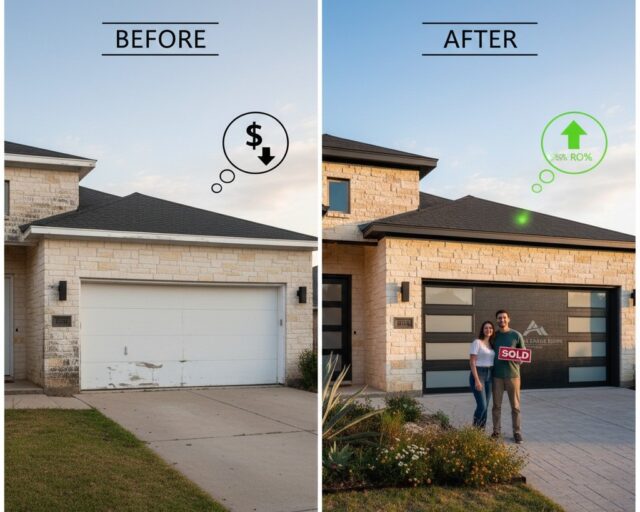
According to the Cost vs. Value Report, garage door replacement consistently ranks as one of the top home improvement projects for Return on Investment (ROI). In many cases, homeowners see a 90% to 100% return on the cost of the project at the time of sale.
In competitive Austin neighborhoods like Tarrytown or Westlake, buyers look for “move-in ready” features. A modern, insulated door from Alpine Garage Doors Texas signals to a buyer that the home has been meticulously maintained and upgraded for the local climate.
Navigating the Austin Landscape: HOAs and Wind Loads
Austin isn’t just about the heat; it’s about community standards and unpredictable weather patterns.
1. Working with Austin-Area HOAs
From the strict aesthetics of Steiner Ranch to the specific color palettes of Circle C Ranch, navigating Homeowners Associations (HOAs) can be a headache. Alpine Garage Doors Texas has extensive experience working within these guidelines. We provide the necessary spec sheets and color samples you need for approval, ensuring your new energy-efficient door meets both your cooling needs and your neighborhood’s architectural standards.
2. Wind Load and Storm Readiness
While Austin isn’t on the coast, we are no strangers to intense spring thunderstorms and high-wind events. A high-quality insulated door isn’t just better at blocking heat; it’s structurally stronger. The “sandwich” construction we discussed earlier adds significant rigidity to the door panels, making them far more resistant to the high-pressure winds that can accompany a Central Texas “Blue Norther” or a severe thunderstorm.
Smart Garage Technology for the Modern Austin Home
As Austin continues its evolution into “Silicon Hills,” our homes are becoming smarter. A truly “best” blog post must address how technology integrates with energy efficiency.
1. Integrated Monitoring
Today’s openers, like the LiftMaster series with myQ technology, allow you to monitor your garage from your smartphone. Why does this matter for energy? Because a door left cracked open by mistake for three hours in August is a massive energy drain. Smart alerts ensure your thermal barrier stays closed when it needs to be.
2. Battery Backups
With the memory of recent winter storms and power grid fluctuations in mind, many Austin homeowners are opting for openers with integrated battery backups. If the power goes out during a heatwave or a freeze, you won’t be trapped or forced to leave your garage door open (and your home’s insulation compromised).
Frequently Asked Questions (FAQs)
1. Will a new insulated garage door make my garage quieter as well as cooler?
Yes, significantly. One of the “hidden” benefits of energy-efficient doors—specifically, triple-layer polyurethane-injected doors—is their acoustic damping properties. Because the door is a solid, dense “sandwich” rather than a hollow sheet of metal, it vibrates much less during operation. This reduces the “rumble” inside the home when the door opens and significantly blocks out external Austin street noise, such as traffic or lawnmowers.
2. Does the color of my garage door affect its energy efficiency in the Texas sun?
It does. In the intense Central Texas heat, darker colors (such as black, charcoal, or dark walnut) absorb more solar radiation than lighter colors (such as white, almond, or sand). If your garage faces west and receives direct afternoon sun, a dark-colored door can become significantly hotter to the touch. If you have your heart set on a dark aesthetic, we recommend ensuring the door has the highest possible R-value and a robust thermal break to prevent that absorbed heat from transferring into the garage interior.
3. How often should I inspect the weatherstripping on my energy-efficient door?
For Austin homeowners, we recommend a quick DIY inspection twice a year: once in late spring before the triple-digit heat hits, and once in late autumn. The Texas sun is brutal on rubber and vinyl; UV rays can cause perimeter seals to crack or become brittle over time. If you see light peeking through the edges of your door when it’s closed, or if you feel a draft, your seals are compromised. Replacing these seals is a low-cost way to maintain the energy-saving benefits of your installation.
4. Can I install an energy-efficient door on my existing garage door opener?
Usually, yes, but there is a caveat. Insulated doors are often heavier than non-insulated, single-layer steel doors. When Alpine Garage Doors Texas performs an installation, we calibrate your spring system to handle the specific weight of the new door so the opener doesn’t have to do the “heavy lifting.” However, if your current opener is over 10–15 years old, we may recommend upgrading to a DC-powered motor. These motors are more energy-efficient themselves and handle the weight of insulated doors with much smoother start-and-stop transitions.
Conclusion: The Alpine Garage Doors Texas Promise
Choosing the right partner for residential garage door installation in Austin, TX, is about more than just picking a design from a catalog. It’s about choosing a team that understands the local climate, the local architecture, and the local commitment to energy efficiency.
At Alpine Garage Doors Texas, we don’t just see a garage door as a piece of moving hardware. We see it as a vital component of your home’s defense against the Texas sun. Whether you are looking to lower your utility bills, boost your home’s value, or finally turn that “oven” of a garage into a usable workspace, we have the expertise to make it happen.
Don’t wait for the next 100-degree streak. Invest in a cooler, quieter, and more beautiful home today.
Ready to Upgrade Your Austin Home?
Contact Alpine Garage Doors Texas for a free, in-home consultation. Our experts will measure your space, evaluate your R-value needs, and provide a transparent quote for an installation that will keep you cool for decades to come.
Call us today at 346-438-1138 or visit alpinegaragedoorstx.com/ to schedule your appointment!
Resources & Further Reading for Austin Homeowners
To help you make the most informed decision about your home’s energy efficiency and garage safety, we’ve compiled a list of helpful local and industry resources:
- Austin Climate Data: See the historical temperature trends for our area to understand why high R-value insulation is a necessity.
- Energy Efficiency Savings: Explore how the city of Austin encourages residential energy improvements.
- Investment Value: View the data on why garage door replacements are the #1 home improvement for ROI.
- City Sustainability: Learn about Austin’s long-term plan for climate resilience and heat mitigation.